HBG
  • Subscribe
  • Digital Edition
    • Digital Edition
    • Digital Brand Index
    • Digital Archive
  • Beverage Guide
    • Flavor and Cocktail Construction >
      • A Guide to: Flavor Pairings and Recipe Development
      • A Guide to: Cocktail Construction
      • Flower Aroma Compounds
      • Peanut Aroma Compounds
      • A Guide to: Herb Aroma Compounds
      • A Guide to: Spice Aroma Compounds
      • Fruit Aroma Componds
      • Japanese Flavors
      • A Guide to Indigenous Mesoamerican Cocktail Ingredients
    • Production Fundamentals >
      • A Guide to: Water
      • A Guide to: Alcoholic Fermentation
      • Intro to the Fermentation of Grain
      • A Guide to: Distillation and Stills
      • A Guide to: Filtration
      • A Guide to: Oak Barrels
      • ​A Guide To: Non-Enzymatic ​Browning
      • Introduction to Cacao and Chocolate Making
    • Non-Alcoholic Beverages >
      • Kamaʻāina Beverages >
        • Hawaiian Sun
      • Non-Alcoholic Beer Produced by Restricted Fermentation
      • Non-Alcoholic Beer and Wine Produced by Dealcoholization
      • Hawaii Beverage Guide Perspective on: Non-Alcoholic Beer and Wine Program Integration
      • 2022 No/Low Alcohol Beverage Market Perspective
    • Beer >
      • Kamaʻāina Brewers >
        • Kauai Breweries >
          • Kaua'i Island Brewing Co.
        • Oahu Breweries >
          • Aloha Beer Co
          • Beer Lab
          • Broken Boundary Brewery
          • Hana Koa Brewing Co
          • Honolulu Beerworks
          • Inu Island Ales
          • Lanikai Brewing Co
          • Waikiki Brewing Company
        • Maui Breweries >
          • Maui Brewing Co
          • Maui Seltzer
          • Kohola Brewery
        • Big Island Breweries >
          • Big Island Brewhaus
          • Ola Brewing
          • Hilo Brewing
          • Kona Brewing
      • Athletic Brewing
      • Firestone Walker Brewing Co
      • Golden Road Brewing
      • Stella Artois Summer Solstice Lager
      • San Miguel
    • Cider >
      • Kamaʻāina Ciders >
        • Paradise Ciders
    • Sake
    • Spirits >
      • Kamaʻāina Distillers >
        • Aloha Awamori
        • Hali'imaile Distilling Company
        • Hanalei Spirits
        • Hawaii Sea Spirits
        • Hawaiian Shochu Co
        • Island Distillers
        • Ko Hana Rum
        • Kolani Distillers
        • Koloa Rum >
          • Koloa Cacao Rum
        • Ko'olau Distillery
        • Kuleana Rumworks
        • Kupu Spirits >
          • Kupu Whiskey
        • Royal Hawaiian Spirits
      • Bitters
      • Brandy >
        • Cognac >
          • Martell
        • Spanish Brandy >
          • Emperador >
            • Fundador
      • Gin >
        • Ginebra San Miguel
        • Indoggo Gin
      • Liqueurs and Cordials >
        • ​Destileria Barako: Ube Cream Liqueur
        • Skrewball
        • Chareau
      • Ready Made Cocktails >
        • 10 Barrels Brewing Co.
      • Rum >
        • Copalli Rum
        • Lemon Hart and Son
        • Real McCoy Rum
        • Tanduay Rum >
          • Tanduay: Especia Spiced Rum
      • Shochu
      • Agave Spirits
      • Tequila >
        • Del Maguey
        • Codigo 1530
        • Tequila Comisario
        • El Cristiano
        • Casa Sauza
        • Real Del Valle
        • Tequila Komos
        • El Hempe
      • Bourbon Whiskey >
        • Old Hillside Whiskey
      • Irish Whiskey >
        • Irish Distillers: Midleton Very Rare, Irish Distillers: Redbreast, Spot Whiskey, Jameson
        • Slane Irish Whiskey
      • Vodka >
        • Kai Vodka
        • Haku Vodka
    • Wine >
      • Kamaʻāina Wine Makers >
        • Maui Wine
      • Winemaking >
        • A Guide to Viticulture
        • A Guide to: Wine Prefermentation Practices
        • A Guide to: Wine Microbes
        • A Guide to: Wine Alcoholic Fermentation Physical Environment
        • A Guide to: Wine Fermentation Chemical Environment
        • A Guide to: Wine Bottling
        • A Guide to: Post Fermentation Flavor Adjustments
        • A Guide to: Post Fermentation Process: Stabilization
        • A Guide to: Wine Faults
        • A Guide to: Wine Polyphenols
        • A Guide to: Wine Aroma Compounds: Pt 1
        • A Guide to: Wine Aroma Compounds: Pt 2
        • A Guide to: High Residual Sugar Wine from Dehydrated Grapes
        • Red and White Grape Aroma Compounds
      • Wine Styles >
        • Natural Wine
        • White Wine Styles >
          • Riesling
          • Sauvignon Blanc
        • Rosé
        • Red Wine Styles >
          • Bordeaux Reds
          • Cabernet Sauvignon
          • Gewürztraminer
          • Grenache
          • Malbec
          • Merlot
          • Non-Alcoholic Wine >
            • Fre: Alcohol -Removed Wine
          • Zinfandel
        • Sparkling Wine
  • Business Strategy
    • Restaurant Finance
    • Your Dapper Consulting: Democratization of Venture Capital
    • Marketing for Small Business Pt 1: Analysis
    • Marketing for Small Business Pt 2: Marketing Communications Strategy
    • A Guide to Pricing Strategy
  • News and Events
    • Cheers to Seventy-Three Years
    • Navigating COVID-19
  • About
    • Contact
    • Terms & Conditions
Picture
Photo By: Eva Elijas/Pexels

A Guide to Cocktail Construction

By; Brent Nakano
Cocktail recipes are generally formulaic. All tend to be derivatives of: Cocktail = Base Spirit + Sweetener + Aromatic Component. Thus, there are a few general cocktail concepts, with the remainder being a variation on the theme in one way or another. However, the way one looks at the core formulas can vary.  Staples of every cocktail book collection should include the following books which provide numerous examples of riffs off of classic cocktails:
  • The Joy of Mixology by Gary Regan
  • The Cocktail Codex by Alex Day, Nick Fauchald, and David Kaplan of Death and Co.,

The following is Hawaii Beverage Guide’s simplified take on the core cocktail formulas, common variations to those core formulas, and some insights on how to think through manipulation of the formula. 

For more specific insight into how flavors work together: 
Guide to: Flavor Pairings and Recipe Development
Clickable Page Menu
Cocktail Ingredients and
​Approach to Variations
Spirit Forward
​Cocktails
Light & Refreshing
​Cocktails
Creamy
​Cocktails
Tomato Based
​ Cocktails
Cocktail DevELOPMENT Worksheet

Ingredients and Approach to Variations

Suggested Pre-Readding
A Guide to: Flavor Pairings and Recipe Development
​

Flavor Theory
  • Taste is defined as what is sensed by distinct taste receptors located on a tastebud. That is: Sweet, sour, salty, bitter, umami (savory), and oleogustus (fatty).
  • ​Chemesthesis: Unlike taste, which is detected by taste receptors, chemesthesis is the chemical activation of sensory receptors on specialized nerve endings. The primary sensations are Carbonation, Spice/Heat, and Cooling/Menthol.
  • Mouthfeel is the physical parameters of food, including texture and temperature.
  • Aroma is created by volatile aromatic compounds being sensed via olfaction and retronasal olfaction.
  • Flavor = Taste (salty, sour, bitter, sweet, umami, oleogustus) + Aroma 

Approaches to Aroma Compound Combinations 

To state the obvious: It is important to coordinate flavors that pair well together, as not all spirits work with all ingredients.  Similarly, not all flavors work well together.  Using large datasets, academic research as found ingredient combinations to be based on how aromatic compounds are combined. Where: 
  • Food-pairing Cuisines (High food-pairing + low food-bridging): Flavors are intensified by mixing ingredients with similar chemical compounds. This is likely the easiest to use, given our current database structure. 
  • Food-bridging Cuisines (Low food-pairing + high food-bridging): Two ingredients that do not share a strong molecular or empirical affinity are bridged through another ingredient or a path of non-repeating ingredients within a network of ingredient affinities. 
  • Avoidance of food-bridging and food-pairing (Low food-pairing + low food-bridging): Ingredients’ flavors contrast.
  • Food-bridging AND food-pairing Cuisines (High food-pairing + high food-bridging): Dishes tend to reinforce the intensity of flavor using both food-pairing and food-bridging. This creates direct and indirect intensification of flavors in a recipe by reinforcing common flavors and smoothing contrasts between flavored ingredients.
  • For more see: A Guide to: Flavor Pairings and Recipe Development
  • For a traditional method on flavor pairing, we highly recommend the Flavor Bible and the Vegetarian Flavor Bible, both by Karen Page and Andrew Dornenburg.  We suggest purchasing the digital version for pocket-sized access on your mobile device.   
Base Spirit 
Base spirit is a loose term that refers to the predominant flavor of a drink, and there is typically 1.5 to 2 oz of base spirit per cocktail. The base spirit does not have to be a distilled spirit, and can also be a beer or wine.  Base spirit variations include:
Split Base

The technique: Base spirits are blended together in a concept similar to a master blender combining different barrels at the distillery. Blending at a bourbon distillery, for example, may consist of combining bourbon aged 7 years with bourbon aged 4 years (the age statement is the youngest product).
  • Flavor theory: The flavor differences between products add complexity to a more interesting spirit while using a similar but cheaper spirit.  
  • Examples: In a cocktail, Unaged Rum + Aged Rum can be combined for different but complementary core flavors.  Other examples include blending Rum + Brandy or Whiskey + Brandy. 

Infusions into the base spirit.

  • Technique: An ingredient is steeped in the base spirit to impart the ingredient’s taste.
  • Flavor Theory: The base spirit's ethanol is used as a solvent to extract flavors from whatever is being infused
  • Example: Cinnamon-infused whiskey.  For potential base spirit - ingredient combinations see the section "Cocktail Ingredients" for suggestions.  
Ingredient Form Factors
There are a multitude of non-alcoholic ingredients that can be used in cocktails.  Often, these flavors are familiar and easier to understand than the complex flavors of spirits, liqueurs, fortified wines and amaros.  For this reason, we typically recommend those getting into mixology start by using a base spirit, and then fresh ingredients that they understand. ​
  • Fresh ingredients are ideal for the same reason fresh (rather than frozen or canned) ingredients are used in the kitchen.  That is, they taste more dynamic and lively.  It should be noted not all ingredients can be used fresh because they may not be able to integrate into cocktails due to their form factor.  Bananas for example are very starchy, and outside of blending, require processing.  
  • Frozen ingredients can be cost effective, and if the ingredients are muddled, they may not matter much.
  • Juiced ingredients are typically more cost effective than fresh, but vary in quality.  Orange juice from concentrate is not as tasty as commercially available orange juice “not from concentrate”.
  • Fruit preserves, like jams and jellies can be used to add fruit as well as add sugar to a drink.   

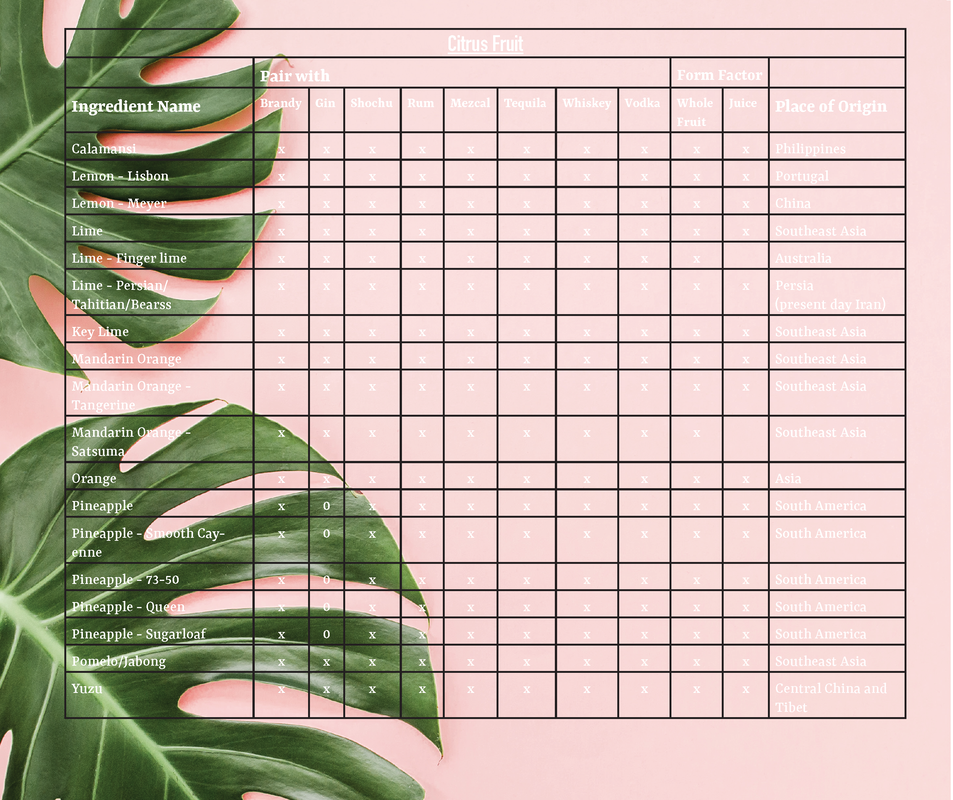
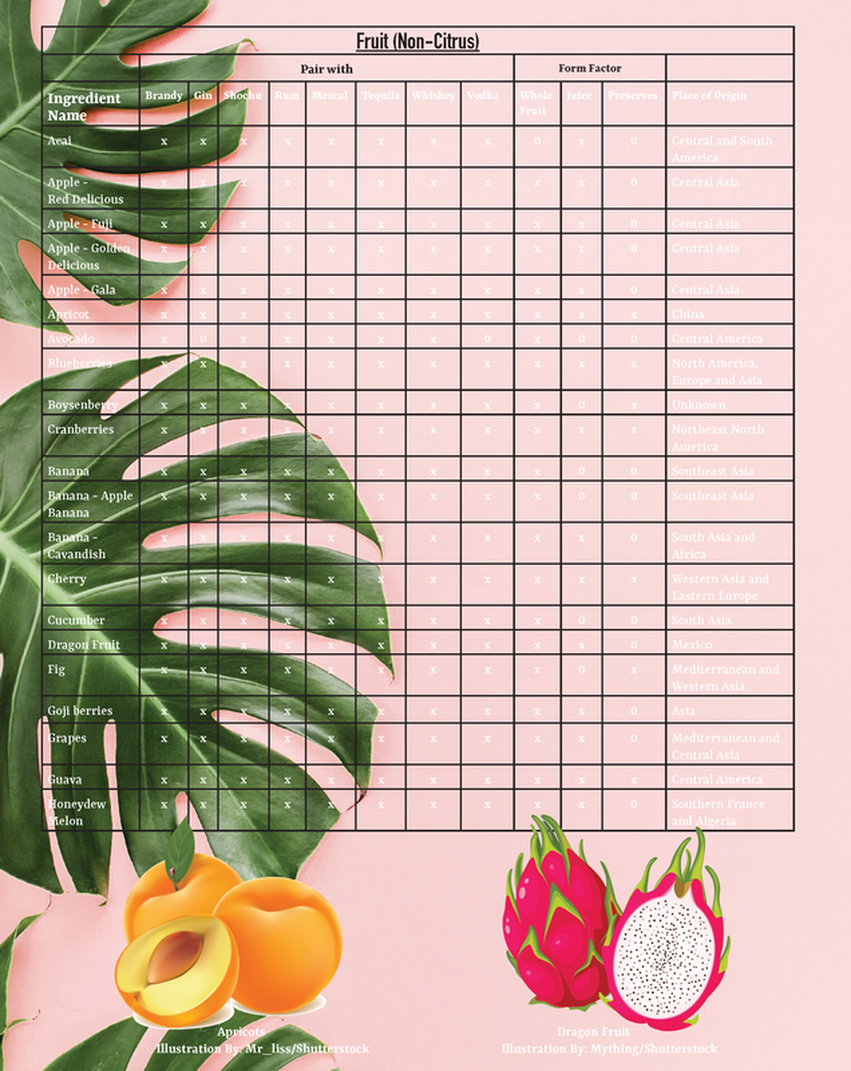
Ingredient Tables
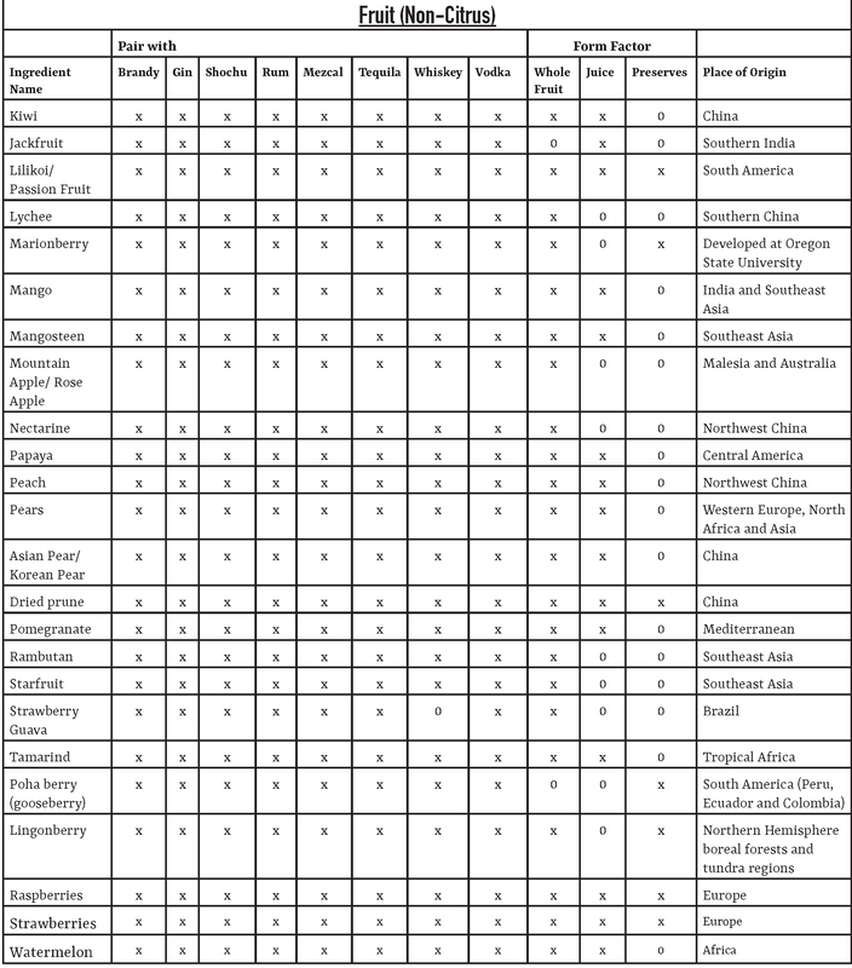
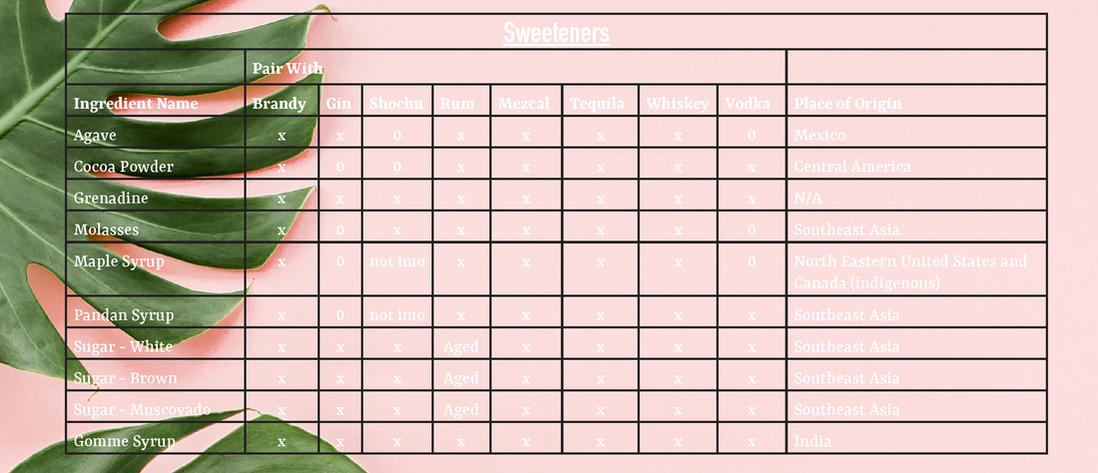
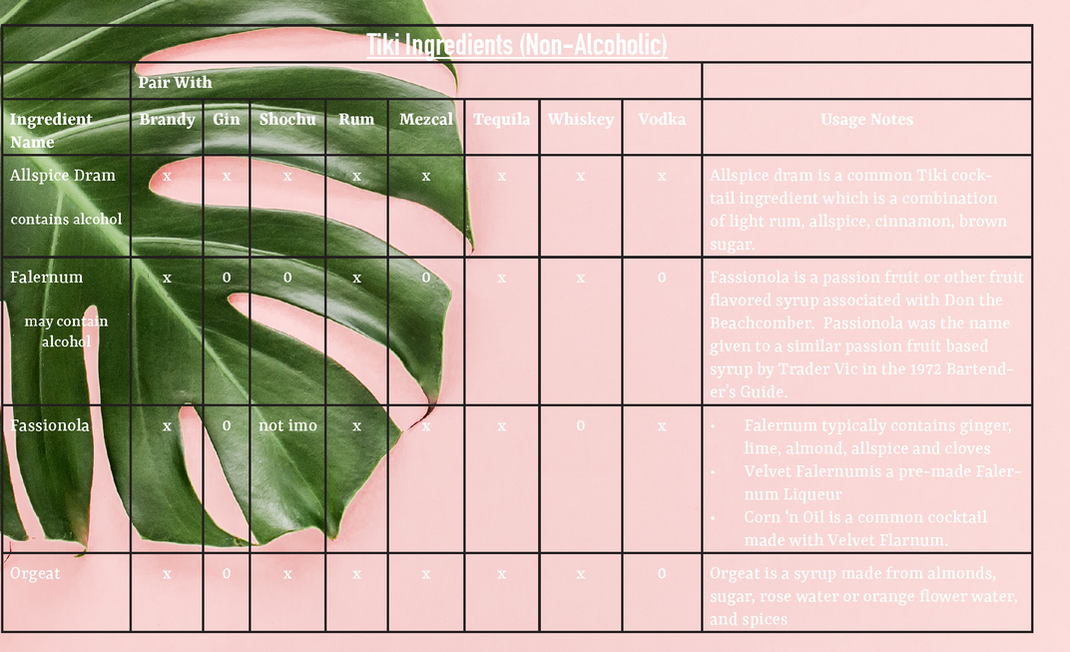
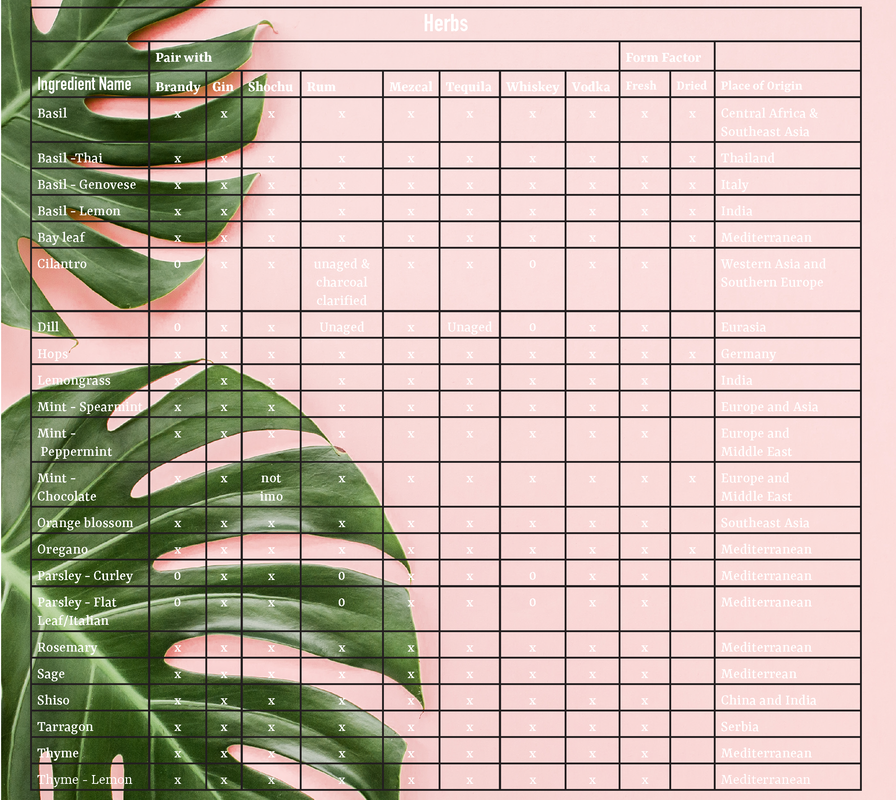
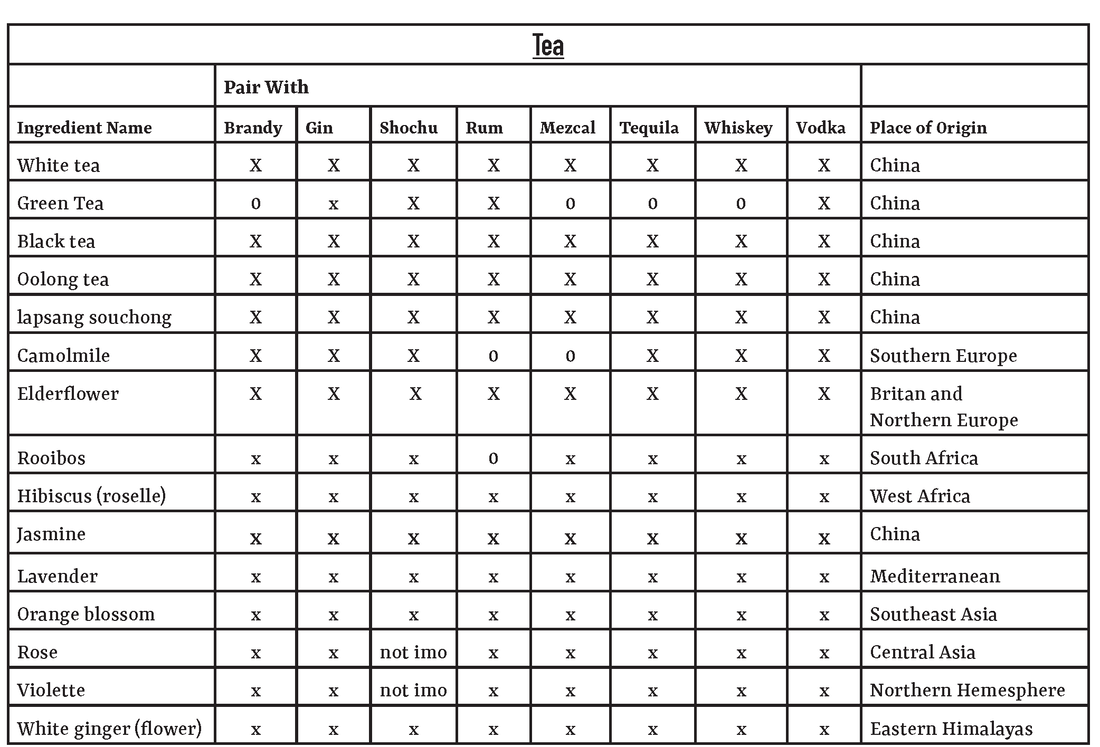
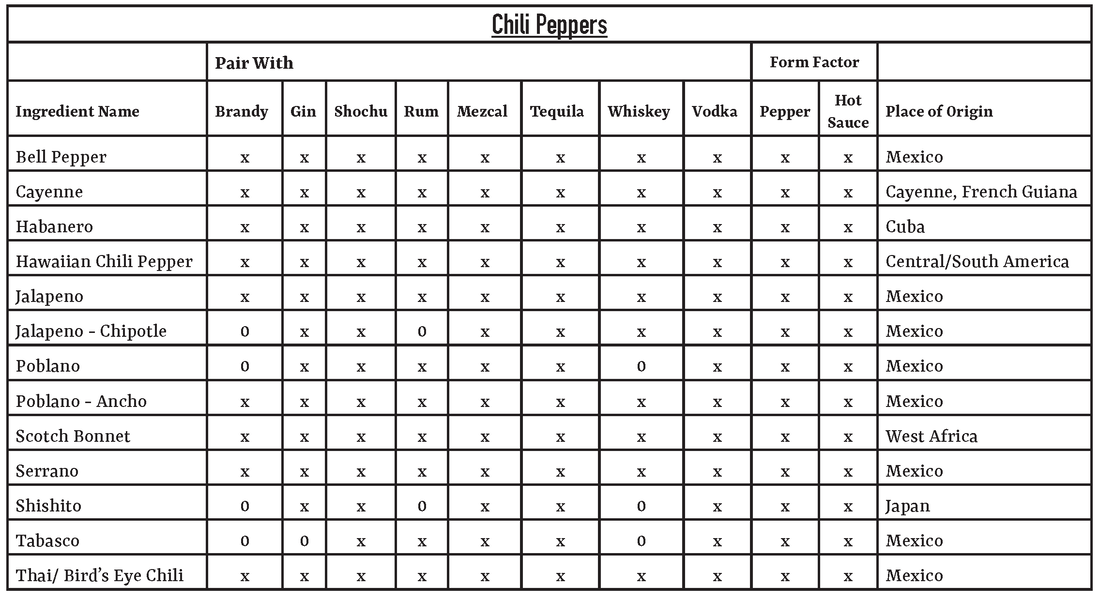
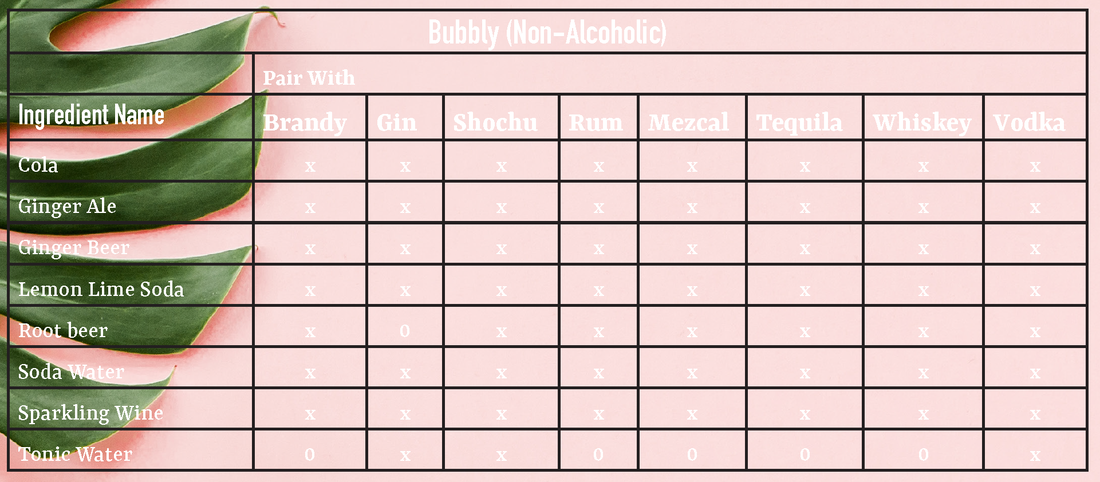
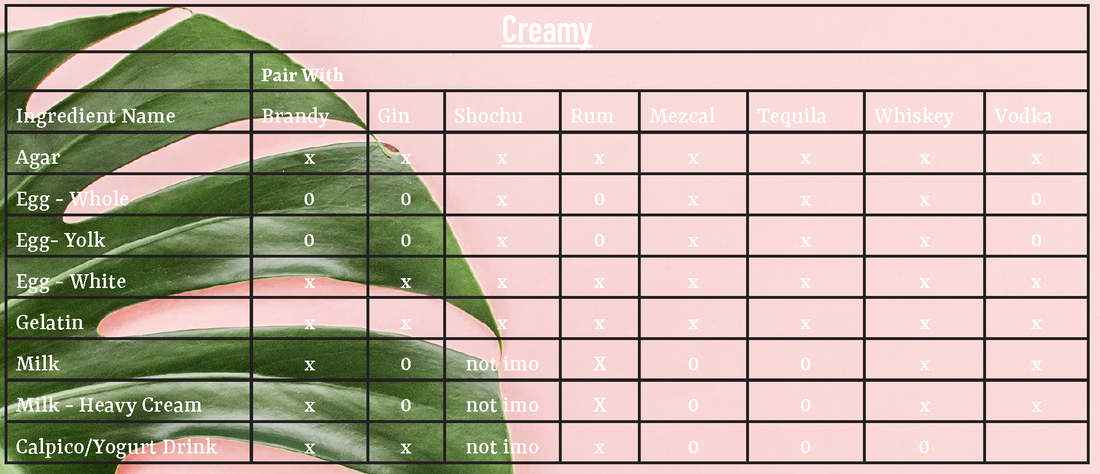
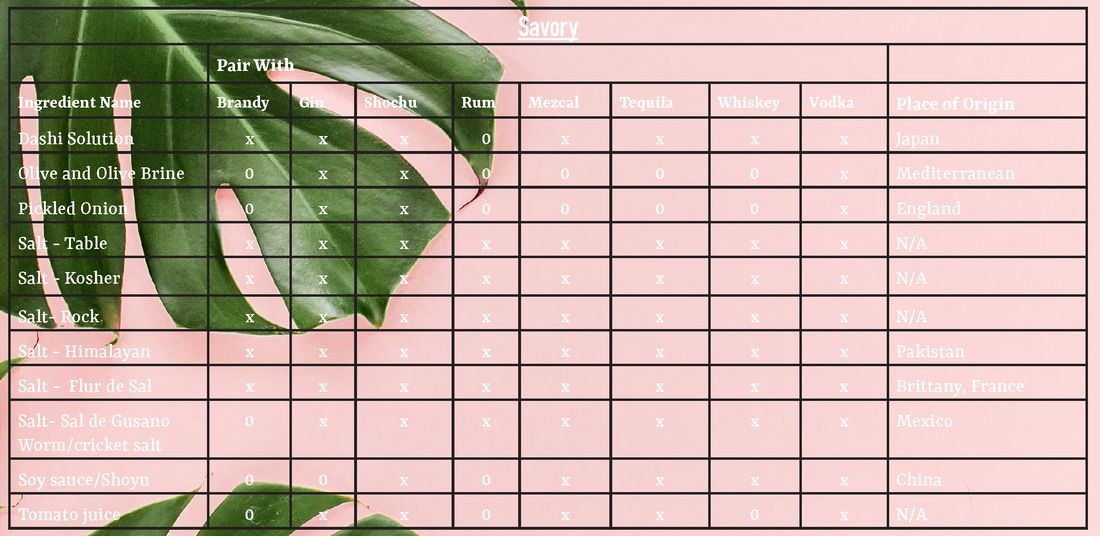
The following are a list of culinary ingredients that can be found in bars and integrated into cocktails. These are intended as quick reference tables and as a checklist for doing cocktail development so that you don't miss ingredients that you're familiar with and just forgot to think about.  They are not intended to be memorized, however many probably already have built flavor recall for all of these products and have their  own opinion on what pairs with what spirits.  We have also included the place of origin for the ingredients so that when doing menu development, there is a quick reference for those interested in telling a cultural story.    On hawaiibevgudie.com there will be additional usage suggestions.  We will also be updating the table periodically with an emphasis of building more accurate spirit pairings. 

Ingredient Table Legend
  • x = pairs with   
  • 0 = does not pair with   
  • not imo = does not pair with imo shochu   
  • aged = only pairs with aged version of spirit

Cocktail Ingredients 

Taste: Bitter and Sweet

  • Liqueur  
  • Wine: Aromatized and Fortified
  • Bitters/Amaro
  • Sweetener/Sugar
  • Fruit (Non-Citrus)
<
>
Liqueur  

Flavor theory
  • Liqueurs ≈ Spirit + Sugar + Fruit and/or herbs ​
  • Taste: Bitter - Sweet    
    Sugar adds sweetness, and alcohol adds bitterness.  The liqueur's sugar, depending on the concentration, can supplement or replace an added sweetener like sugar. Bitterness can replace that from a base spirit. 

  • Aroma:  Aromatic complexity is created by the featured ingredient.

Styles and pairings
  • ​Fruit liqueurs
    • High-acid fruits like orange bitters and yuzu bitters provide limonene, an aromatic compound also found in gin and cocktails with citrus in them.
    • Fruits that could be used as pie filling, for example, cherry (maraschino liqueur), and blackberry (creme de Mure), pair with aged base spirits as they complement the baking spice aromas. These also pair with ester-driven sprits like sugarcane distillates. 
  • Herbal liqueurs  = Base spirit + Herbs (no bittering agent): Different in taste from amaro, but with similar approaches to aromatics, these pair with terpene-driven spirits like gin and tequila. 
Wine: Aromatized and Fortified

Flavor theory
  • Wine = Ethanol (spirit) + Wine Aroma
  • Taste: Classic bitter-sweet taste of many beverages, including cola
  • Aroma
    • Fortified wine adds aromatic complexity from the wine itself.
    • Aromatized wine adds sweetness, bitterness, and aromatic complexity which is derived from both the wine and aromatic ingredients.

Styles and pairing approaches
  • Fortified wine = Wine + Sugar + Ethanol
    • ​Fortified wine pairs with aged spirits due to flavor pairing theory, as both are influenced by barrel aging and the aroma compounds derived from the process.
    • Fortified wine can be combined with bitters and act as a replacement for Aromatized wine where: Fortified Wine + Bitters (Aromatic/cocktail and/or Amaro/Potable).
  • ​Aromatized Wine = Wine + Sugar + Ethanol + Bittering Agent + Herbs, Spices and other Aromatic Ingredients
    • ​​Vermouth = Wine + Sugar + Ethanol + Wormwood + Spices and Herbs for aromatics
    • Americano = Wine + Sugar + Ethanol + chinchona bark + Spices and Herbs for aromatics
    • Vermouth styles and Bitter Aromatized Wine styles with caramelized sugar:
      • Pair with aged spirits because of the baking spice notes derived from oak barrels.
      • Examples include Sweet/Rouge vermouth
Bitters/Spice (Aromatic Component)
(more information hawaiibevguide.com/bitters)

Flavor Theory
  • Cocktail bitters = Spirit + Bittering agent + Aromatic ingredients 
  • Potable bitters/Amaro = Spirit + Bittering agent + Aromatic ingredients + Sugar + Water
  • Taste:
    • Cocktail bitters: Bitter
    • Amaro: Bitter-sweet.
  • Aroma: See "styles and pairings" Both cocktail bitters and amaro add bitterness and aromatic complexity.  And, as noted in A Guide to Flavor Pairings and Recipe Development bitter balances:
    • Umami/Salty, exemplified in rimming a tequila glass with salt.
    • Sweet, exemplified in bittersweet drinks like cola and cocktails.
  • Styles and pairings
    • Baking-spice forward bitters, (those containing cinnamon and clove): Aged spirits barrel-derived baking spice notes are enhanced by adding the same aroma compounds of eugenol and cinnamaldehyde. This is why Angostura bitters often appear in classic cocktail recipes.
    • Citrus-forward bitters enhance the citrus aromas from fermentation, like citronellol.
    • Fruit bitters, which can also be used as pie filling, lean into the baking spice notes from the aged spirits.
    • Chocolate bitters can enhance aged spirits’ Maillard reaction compounds from oak barrels and malted barley.
    • Anise bitters like Peychaud's provide licorice notes complimenting aged spirits' baking spice aromas.
    • Celery bitters, if derived from celery seed, are high in limonene and β-pinene, while Beta-selinene provides a woody and spicy aroma.   These aromas complement aged spirits and terpene-forward spirits like tequila and gin.​
  • Substitutions
    • Cocktail bitters (like Angostura) for potable bitter (like amaro).  It is important to note that bitters come in a wide variety of flavors therefor are not completely interchangeable.  
    • Vermouth, a fortified wine with a bitter component, can also be used instead of bitters.
Sweetener/Sugar
Sugar can be thought of as shorthand for sweetener.  It is one of the easiest ways to add complexity or variation to a cocktail, as sweetness can come from a multitude of ingredients.
 
Flavor Theory
  • Taste and aroma:  While white sugar is common because it contributes sweetness without aroma, other types of sugar can add aromatic complexity. As noted in A Guide to Flavor Pairings and Recipe Development
    • Sweet counteracts
      • Bitter, exemplified in its counteracting the taste of alcohol.
      • Sour is exemplified when adding sugar to lemons to make lemonade.
      • Spice is exemplified when spicy food is paired with high residual sugar, as found in Riesling wine.
    • Sweet enhances
      • Salty, exemplified in a margarita salted rim.

Styles and Pairings
  • While white sugar is the most common, sweeteners that enhance caramelization and Maillard reaction compounds are also found in Whiskey from oak aging. Examples include Agave nectar, Cocoa powder, grenadine, molasses, maple syrup, pandan syrup, sugar (brown, muscovado), gomme syrup, glucose syrup, and stevia.
  • Flavored syrups can take the place of a liqueur. Pandan, for example, provides 2-acetyl-1-pyrroline, a Maillard reaction compound also found in whiskey (though reduced by the Lincoln County process).

Supplements and substitutions
  • Using syrups (flavored and unflavored), liqueurs, or fortified wines instead of sugar adds a sweetening component while also contributing to the cocktail’s flavor profile.
  • ​Sour Mix can replace a sweetener
  • Fruit is an alternative to sugar as a source of sucrose
Picture
Fruit (Non-Citrus)
Sweet, non-citrus fruit that is freshly muddled into a cocktail or used as juice

Flavor Theory 

Sweet, non-citrus fruit which is freshly muddled into a cocktail can add:
  • Taste: Sweet    
    The amount of sweetness contributed by the fruit varies.  This can replace the usage of a liqueur or sweetener
    .
  • Aroma: Aromas are directly contributed to the cocktail via mudding or juice.
Styles and pairings
  • Aroma Intensity
    • ​​Ranking: A fruit’s liquid-to-flavor ratio. The chart is divided into high, medium-high, medium-low, and low flavor intensities according to the opinion of Hawaii Beverage Guide.  An analytical ranking methodology is being developed. 
    • Pairings: Flavor intensity should be at or above the cocktails’ flavor intensity so that the flavor of the fruit does not get overshadowed, and that the cocktail does not get over-diluted.
  • Fruit Acidity
    • Ranking: Acidity is influenced by Total/Titratable Acidity and pH.  The acidity groupings are the opinion of Hawaii Beverage Guide.  An analytical ranking based on the academic literature is being developed.
    • Pairing: Fruits with higher acidity change the cocktail’s taste more significantly than fruits with lower acidity. For this reason, we have annotated when acidic ingredients are appropriate in a cocktail style.
Picture
Picture

Taste: Sour, Salty, and Oleogustus

  • Acid: Citrus, Sour Mix, and Types 
  • Umami (Savory) and Salty
  • Oleogustus/Creamy Ingredients
<
>
Acid (like citrus, Sour Mix and types)
Flavor Theory:


Citrus aromatic pairings are more dependent on the supporting ingredients than the base whiskey. In general, as noted in A Guide to Flavor Pairings and Recipe Development
https://www.hawaiibevguide.com/flavor-pairings-and-recipe-development.html#taste

  • Taste: Sour
  • Aroma:
    • Citrus specifically provides the  aroma compound limonene (orange or lemon aroma) and other aromas.
    • Alternative acids provide their own set of aromatic compounds that are aletrantives to citrus, while sill providing "acid balance".        
  • Sour balances
    • Spicy, exemplified in Kimchi or hot sauce, which contains vinegar.
    • Sweet, exemplified in sweet tarts wine.
    • Bitter, exemplified in bitter greens sauteed with lemon and garlic.
  • Sour enhances
    • Salty and Umami are exemplified by pickles like umeboshi (pickled plum) and cucumber pickles.

Styles and pairings

  • Citrus fruits  
  • Alternative acid additions can be found purified or in food products, including Citric acid from citrus juice, Acetic acid from vinegar, Malic acid from grapes, wine, and cider, phosphoric acid in traditional seltzer, lactic acid as found in yogurt, ascorbic acid, as found in vitamin C (not to be confused with citric acid).
  • ​Sour Mix: Shorthand for Acid Element + Sugar, sour mix is another highly flexible component in cocktails. This can be manipulated by:
    • Changing the citrus. Citrus creates sour notes by contributing citric acid.
    • Using a different acid.  For example acetic acid (vinegar), malic acid (apples), tartaric acid (grapes), lactic acid (yogurt) can be used.
    • Manipulation of sweetener as seen above.
Picture
Usage Approach:  
  • When using citrus juice, it is crucial to recognize that each fruit has its own unique flavor and ripeness.  This means the proportion of sugar may need to be adjusted to reach the desired end flavor.
  • Citrus oils can impart a flavor essence without the citric acid brightness. These oils can be expressed by squeezing them over the top, flaming them with a match (lighter fluid can influence the taste), rubbing them on the rum of the glass, or muddling them into the drink.
  • When muddling citrus in a drink, the pith can provide bitterness due to its concentration of tannins, in particular the phenol compound naringin.  This can be good as it can tone back sweetness, or bad if you’re trying to keep a clean flavor profile.
  • Citrus that is approximately 4 hours old is preferred over fresh pressed citrus.  The result was found in a tasting panel conducted by cocktail author, and Booker and Dax owner Dave Arnold.  His perspective can be found here: http://cookingissues.com/2010/10/01/fresh-lime-juice-wtf/ 
  • Pineapple and other fruits that are high in citric acid, though not citrus fruits, can be used in a similar way.​
Umami (Savory) and Salty

​Flavor Theory
  • Taste: While cocktail utilization is similar.
    • Umami is the perception of savory or meaty flavors. 
    • Salty is the perception of sodium chloride and other similar ionic compounds. 
  • Aroma: Highly ingredient dependent, as salt (salty) and MSG (savory) provide no aroma compounds.
  • Cocktail utilization is similar.
    • Salty/umami enhances sweetness, exemplified in salted caramel and chocolate-covered pretzel.
    • Salty/umami counteracts bitterness, exemplified in brined olives.
Styles and pairings
The quantity of salt added matters, as a light touch will not make the cocktail savory, and a heavy dosage can make a light and refreshing cocktail into a savory cocktail.
  • Neutral salts (no aromatic influence): Table salt, Kosher salt, Himalayan salt, Fleur de Sel salt
  • Ingredients influenced by Maillard reaction (toast), caramelization reaction (caramel), and pyrolysis reaction (smoke) compounds: Pair with aged spirts as they enhance the earthy, smoky, and toasty aroma compounds. These include: Dashi solution, Sal de Gusano salt (worm/cricket salt), and soy sauce/shoyu.
Picture
Oleogustus/Creamy Ingredients
Flavor theory
  • Taste: Oleogustus/Creamy ingredients provide taste and texture. These ingredients can create foam when shaken or enhance mouthfeel through fat-washing and by infusing minimal amounts of lipids (fats). 
  • Aroma: Aromatic contributions are highly variable. 
  • As noted in A Guide to Flavor Pairings and Recipe Development hawaiibevguide.com/flavor-pairings-and-recipe-development.html#taste
    • Oleogustus enhances
      • Umami, exemplified by well-marbled steak.
      • Sweetness is exemplified by ice cream and other sweet desserts.
    • Oleogustus counteracts
      • Bitterness, exemplified by the addition of creamer to coffee.
      • Acidity is exemplified by the mixing of oil and vinegar in dressing.

Styles and pairings
  • Non-chill-filtered spirits preserve fatty acids instead of removing them for aesthetics
  • Ingredients with aromas that pair with baking spice like cream, butter, fat (used in fat washing), and olive oil.
  • Aromatically, some creamy ingredients like milk products (butter, cream, etc.) can be associated with diacetyl (buttery aroma). Whiskey pairs well with ingredients that lend themselves to baking spices. 
  • For more, see the list in “A Guide to Cocktail Construction.”
    https://www.hawaiibevguide.com/cocktail-construction.html 
Picture

Chemesthesis: Spicy and Effervescent

Suggested pre-reading: Flavor Pairings and Cocktail Development: Chemisthesis
https://www.hawaiibevguide.com/flavor-pairings-and-recipe-development.html#chemesthesis
  • Soda Water/Carbonated Mixers
  • Spice (As in chili pepper)
<
>
Soda Water/Carbonated Mixers
Soda water can be replaced with a flavored soda, or it can be replaced by another carbonated beverage like sparkling wine.  It should be noted that tonic and soda water are not interchangeable. 

Flavor Theory
Adds texture through both the chemesthesis sensation of tingling or stinging AND the actual physical feeling of bubbles. Also enhances aroma through the aerosolization of aromatic compounds. 
 

​
Picture
Spice (As in chili pepper)
Flavor theory

  • Mouthfeel is enhanced through chemesthesis, and aromatically, spicy ingredients add complexity.
  • As noted in A Guide to Flavor Pairings and Recipe Development hawaiibevguide.com/flavor-pairings-and-recipe-development.html#taste spicy balances:    
    • Sour, exemplified by the pairing of pineapple and chili pepper.
    • Sweet, exemplified by the pairing of Riesling wine and spicy Thai food.
Styles and Pairings
  • Green chilies are influenced by grassy aromas from C6 aroma compounds like hexenal and hexenol. 
    • Examples include shishito pepper, green bell pepper, poblano and green jalapeno.
    • Pair with: Unaged spirits.
  • Fruity chili is influenced by esters.  These chili are picked ripe (not green) and are different than dried chili.  
    • Examples include habanero, Thai/Bird’s Eye Chili, and  Hawaiian chili pepper.
    • Pair with: Unaged and aged spirits
  • Dried chili provides additional fruit aromas compared to fresh ripe chili, as well as Maillard reaction compounds.  
    • Examples include Cayenne, Ancho and Chipotle. 
    • Pair with: Unaged and aged spirits
  • Smoked chili are also ripe and dried therefore add aromatic compounds like fruity esters, Maillard compounds, and volatile phenols (smoke).  
    • Examples include smoked chipotle and smoked/Spanish paprika.
    • Pair with: Unaged and aged spirits


Picture

Aromatic Ingredients: Herbs and Spices

​The following types of ingredients accent a cocktail rather than change its core concept (and thus its category).  This is similar to cooking, when a small portion of vegetables and hot sauce added to a dish does not typically mean the dish is now called something else.  ​
  • Aromatic Herbs, Flowers and Teas
  • Aromatic Spices and Tiki Syrups
<
>
Aromatic Herbs, flowers and teas
In refreshing cocktails, mint is the classic fresh herb. It’s popularity is closely followed by basil, however rosemary, thyme, and sage are also great alternatives.  All fresh herbs can be muddled directly into the cocktail to add a pop of aromatic freshness.  Another option is a herbal liqueur.

Flavor Theory
Herb, flower and tea usage should elaborate on “top note” aromatics. While mint is the standard fresh cocktail herb, the choice is flexible due to C6 (six-carbon) aldehydes and alcohols like hexenal and hexenol, providing “green” aromas that are ubiquitous in all herbs.  Other common tea and herb aroma compounds include linalool, limonene,and 1,8–cineole (eucalyptol).


Ideal products/styles
Picture
Herb Usage Notes 
  • Herbs can be used to provide fresh aromatic notes.  Herbs, combined with citrus can be particularly helpful when trying to keep a drink from being syrupy, cough medicine or artificial tasting. ​​
  • Herbs with prominent C6 (six carbon) aroma compounds have "green", "grassy" notes.  Cilantro and parsley for example. These can clash with aged spirits.   
Picture
There are two major styles of tea
  • Tea from the leaves of the Camellia sinensis plant. This includes in order of oxidization, green tea, white tea, oolong tea, and black tea.
  • Herbal “tea” which does not come from tea leaves but are rather a mixture of flowers, herbs and spices.​

​Tea Usage Notes
  • Tea gives a highly aromatic complexity to a cocktail.
  • Lapsang Souchong adds a smoky flavor as it is smoked
  • Some Tea has Maillard reaction aromas which pair well with aged spirt.  Black tea, Oolong tea, Lapsang souchong, Rooibos, Hibiscus (roselle), for example.
​Aromatic Spices
Spices provide aromatic complexity and can be added to most cocktail styles either by using bitters, integrating them into a syrup like orgeat or grenadine, or the addition of a spice driven liqueur.

​Flavor theory
Using the flavor pairing method, ideal spices enhance oak aging aroma compounds like vanillin, eugenol, and cinnamaldehyde.  Or they compliment them, like in the case of licorice.


Ideal products include
Aged spirits pair well with spices that contain or pair with baking-spice aroma compounds like eugenol,  cinnamaldehyde, and vanillin.  Examples incude: 
  • Allspice, anise, annatto, cardamom, cinnamon, cloves, cumin, ginger, nutmeg, paprika (smoked) or Spanish paprika, peppercorns, star anise, turmeric, red pepper flakes, and various types of vanilla — Tahitian and  Madagascar/Bourbon.
  • Spice-driven Tiki syrups like Allspice Dram, Falernum, Fassionola, and Orgeat
Picture

Cocktail Ice

Ice controls the dilution of a cocktail.  In particular, craft cocktail ice is ideal because it does not contain air pockets that cause ice to melt faster.  This means that the cocktail remains chilled without becoming watery.  

Typical ice shapes and sizes are:
  • Crushed Ice increases dilution of the drink.  In a Mint Julep for example, the crushed ice makes the cocktail fairly light and refreshing for being predominantly made of bourbon.  
  • 1” x 1” cubes
    • Volume: 1 cubic inch
    • Surface Area: 6 square inches.
    • Created by: A Kold Draft or Hoshizaki craft ice machine.
    • Usage: General purpose cocktail ice. 
  • 2” x 2” cubes, spheres and diamonds
    • Volume:  Cube (4 cubic inches), Sphere (~4.19 cubic inches)
    • Surface area: Cube (24 cubic inches), Sphere (~12.57 square inches)
    • Created by: Cutting from a block of ice, however Hoshizaki and Kold Draft now have machines that make 2” cubes.  
    • Usage: Stirred cocktails served in Rocks glasses. The size compared to smaller cubes has less surface area therefore melts more slowly. The shape, while influential on surface area (sphere has least and diamond has most), is mainly for decoration unless the cocktail will be consumed VERY slowly.
  • 1.5 inch x 1.5 inch x 5 inch Collins "spears" (dimensions are glassware dependent)
    • Volume: 11.5 Cubic Inches
    • Surface Area: 34.5 square inches
    • Created by: Cutting from a bock of ice or manually frozen in trays for Collins Ice.  
    • Usage: In highball glasses for effervescent drinks, as these spears minimize surface area compared to cubes.

Quantity of Ice
Ice is generally dependent on the cocktail glass size, however only one 2x2 cube/sphere or Collins Spears is used per drink.

For more insight into the multitude of variations on craft cocktail ice and how to make it
  • The Ice Book by Camper English
    https://www.alcademics.com/the-ice-book-by-camper-english.html
  • Camper English’s Alcademics blog
    https://www.alcademics.com/index-of-ice-experiments-on-alcademics.html ​

Mixing method: Shaking versus Stirring and Straining

Stirring
  • Dilution:  Minimized
  • Occurs in: A Mixing glass at craft bars for aesthetics, though stirring in a cocktail shaker .
  • Used for: High-flavor-intensity cocktails, especially those not served on ice. Stirring minimizes air bubble formation which can make the drink appear cloudy.
  • Strain using: Julep strainer. This strainer captures larger pieces of ice.  Named after the cocktail, it was used to restrain the ice when drinking from a cup, as straws were not yet popularized.
​
Shaking
  • Dilution: Increased
  • Occurs in: Shaking tin.  The specific type is generally personal preference. 
  • Used for: Low-flavor-intensity cocktails. These benefit from increased dilution, and cooler temperatures. 
  • Strain using: Hawthorne strainer.  Hawthorn strainers help to remove the ice shards that form though shaking.

Double Straining
Double straining utilizes a fine strainer to capture any small particulate including fine ice shards and muddled pieces of herbs and fruit. 

Glassware and General Cocktail Proportions

There is a multitude of specialized glassware, each for a specific type of cocktail.  However, it is not economical for many establishments to have two glasses of the same volume, and almost but not exactly, the same shape.  Additionally:

​Stemware: Coupe vs Martini Glass vs Nick and Nora Glass: 
  • Usage: Stemware is used to serve spirit-forward drinks that do not contain ice because the stem prevents the drinker’s hand from warming the glass and its contents.  
  • Differences: Coupes and Martini Glasses are the same size, with Nick and Nora Glasses being slightly smaller.  However, Coupes and Nick and Nora glasses have a lip which decreases spillage.
  • Size: 5-7 ounces   
    ​
Tall Cylindrical Glasses: Highball Glass vs Collins Glass  
  • Usages: Tall, cylindrical glasses are used    when there is a considerable amount of mixer like soda in the cocktail. 
  • Differences: Highball glasses are  generally shorter and wider and have less volume than Collins Glasses.  However, the volume and the height of a tall cylindrical glass varies by manufacturer which makes nomenclature highly subjective.
  • Sizes: 10-16 ounces

Short Cylindrical Glasses:  Old Fashioned Glass vs Rocks Glass:
  • Usages: Short, cylindrical glasses are used for more concentrated cocktails that contain ice.  
  • Differences: These two glasses are generally synonyms of each other.
  • Sizes: 6-8 ounces
General Cocktail Proportions
Whenever modifying or replacing ingredients, proportions may need to be adjusted. 
  • Base Spirit: 1.5 -2 oz base spirit
  • Dilution/Ice: 0.25-0.75 oz water from melting ice (stirless melting occurs when stirring vs shaking)
  • Aromatized wine or amaro: 0.5-1.0 oz
  • Total liquid volume: Generally dependent on the glass size.

Picture

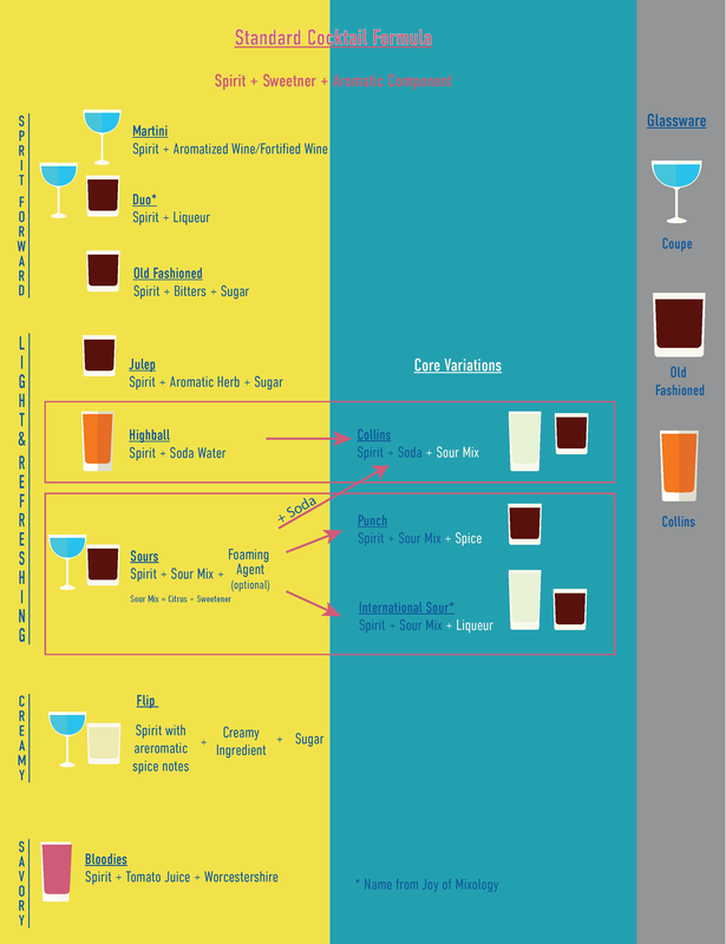
Cocktail: Base Spirit + Sweetener + Aromatic Component 

Notes on Cocktail formulas:
  • Classic Examples are cocktails considered “Classic Cocktails.” 
  • Substyles are cocktails that require more specific ingredients than the overall style, and have many common variations that are considered “classic cocktails”. 
  • Cocktail Feel is how boozy and spirit forward or light a cocktail is.  This generally breaks down to: Spirit Forward, Light Refreshing, Creamy and Savory.  When creating a cocktail for a guest, this is one of the key questions asked. 

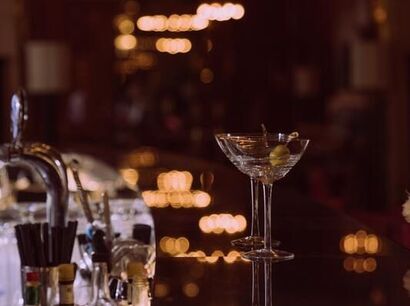
Martini

Martini = Base Spirit + Aromatized Wine/Fortified Wine
  • Cocktail Feel: Spirit Forward
  • Technique: Stirred with ice
  • Ice in Serving Glass: No
  • Glassware: Coupe or Rocks Glass
  • Classic Examples:  Martini, Manhattan, Adonis
  • Flavor Concept
  • Additional Ingredients 
<
>
Flavor Concept
  • Taste: Bitter-Sweet. Astringency from the alcohol is balanced by sweetness from Vermouth/Aromatized Wine while also adding a different type of bitterness.
  • Aromatics: The aromatics of the base spirits are complemented and enhanced by those of the aromatized wine. Vermouth is a specific aromatized wine that uses Wormwood for bitterness, whereas Americano uses chinchona.  
Additional Ingredients and Substyles

Amaro (Manhattan + Amaro = Negroni)
  • Ingredient addition, supplementation, or replacement: Supplement or, replace Aromatized wine/Vermouth with the addition of amaro.
  • Style/Substyle evolution with usage: Negroni = Base Spirit +  Aromatized Wine + Amaro

​Fortified Wine + Cocktail Bitters
  • Ingredient addition, supplementation or, replacement: Supplement or replace Aromatized wine (Aromatized Wine ≈ Fortified Wine + Cocktail Bitters) with the addition of Fortified Wine + Cocktail Bitters.
  • Style/Substyle evolution with usage: None

Liqueur
  • Ingredient addition, supplementation or, replacement: Liqueur addition (Base Spirit +  Aromatized Wine + Liqueur)  
  • Style/Substyle evolution with usage:  The addition of liqueur evolves the cocktail to overlap with the category of Duos. The delineation is semantic but useful for teaching, data collection, and data analysis.
​​Martini Substyles
Negroni = Base Spirit + Amaro + Aromatized Wine
  • ​Mixing method: Stir with ice
  • Ice in Serving Glass: No
  • Glassware: Coupe or Rocks Glass
  • Classic Examples:  Boulevardier, White Negroni, Old Pal

Picture
Photo by: Unsplash/cottonbro

Duo

(Category Name from Joy of Mixology by Gary Regan)
Duo = Base Spirit + Liqueur
  • Cocktail Feel: Spirit Forward
  • Technique: Shaken with ice
  • Ice in Serving Glass: Cubes
  • Glassare: Rocks Glass
  • Classic Examples:  Godfather Cocktail, Rusty Nail, Stinger Cocktail, Black Russian, Alaska Cocktail, , Kir, Kir Royal
  • Flavor Concept
  • Additional Ingredients
<
>
Flavor Concept
  • Taste: Bitter-Sweet
  • Aroma: The base spirit is complimented/enhanced by the liqueur.
Additional Ingredients and Substyles

Bitters (aromatic and amaro)
  • ​Ingredient addition, supplementation or, replacement: Addition to Duo recipe (Base spirit + Liqueur + Bitters) 
  • Style/Substyle evolution with usage: Liqueur addition to the Duo recipe overlaps with the Martini style. The delineation is semantic but useful for teaching, data collection, and data analysis. 
​
Fresh Fruit + Sugar
  • Ingredient addition, supplementation or, replacement: Fresh fruit + Sugar can replace the Liqueur. Given the lower ABV, it evolves the cocktail style from being spirit-forward into something light and refreshing.
  • Style/Substyle evolution with usage:  
    • If the fruit is citrus then the cocktail evolves into the Sour cocktail style
    • If the fruit is non-citrus it is more akin to the Fix substyle of the Sour cockail style. 
Duo Substyle

​Sangaree (not to be confused with Sangria) = 
Wine + Base Spirit (optional) Sugar + Spice (typically grated nutmeg)​
  • ​Mixing method: Stir with ice
  • Ice in Serving Glass: No
  • Glassware: Wine Glass
  • Classic Example: Port Wine Sangaree

Picture
Photo by: Unsplash/Pylyp Sukhenko

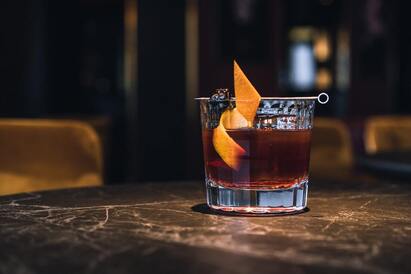
Old Fashioned

Old Fashioned = Base Spirit + Sugar + Bitters
  • Cocktail Feel: Spirit Forward
  • Technique: Stirred
  • Ice in Serving Glass: Depends on the desired end dilution or on glassware
  • Glassware: Can be served up (in a coupe), or in a rocks glass (over ice)
  • Classic Examples: Old Fashioned, Sazerac 
  • Flavor Concept
  • Additional Ingredients
<
>
Flavor Concept
  • Taste: Bitter-Sweet. The spirit is sweetened by sugar/sweetener.
  • Aroma: The base spirit's aromas are enhanced by the bitters.
Additional Ingredients and Substyles
Liqueur 
  • Ingredient addition, supplementation, or replacement: Supplement sugar with liqueur for additional aromatic complexity.  Its also similar to muddling of maraschino cherries. 
  • Style/Substyle evolution with usage: Liqueur usage overlaps with the Duo style. The delineation is semantical but useful when teaching and for data collection and data analysis. 

Aromatized Wine 
  • Ingredient addition, supplementation, or replacement: Vermouth can supplement a portion of the bitters.
  • Style/Substyle evolution with usage: Usage overlaps with the Martini style. The delineation is semantical but useful when teaching and for data collection and data analysis.
Old Fashioned Stubstyles
​
Most Old Fashioned variations revolve around the base spirit and the type of bitters.
​
Champagne Cocktail: Sparkling Wine + Sugar + Bitters 
  • Technique: Not stirred or shaken in the original cocktail, but stirred if integrating ingredients due to effervesce of champagne 
  • Ice in Serving Glass: No 
  • Glassware: Champagne Flute
  • Classic Example: Champagne Cocktail, Bellini
  • Variations
    • Base: Some Champagne can be replaced by a spirit or fortified wine
    • Sugar can be replaced with fruit as in the case of Bellini

Julep

Julep = Base Spirit + Sugar + Fresh Herb
  • Cocktail Feel: Light and refreshing. Due to the high water content from high dilution, it is similar to a Highball without the carbonation.
  • Technique: Muddled then shaken with ice
  • Ice in Serving Glass: Juleps are served with crushed ice, but as a variation less ice can be used.
  • Glassware: Rocks Glass
  • Classic Example:  Mint Julep 
  • Flavor Concept
  • Additional Ingredients 
<
>
Flavor Concept
  • Taste: Bitter-Sweet
  • Aroma: The whiskey’s aromas are “opened” through dilution by crushed ice. Herbs are used for aroma. 
Additional ingredients and Substyles
Liqueur
  • Ingredient addition, supplementation, or replacement: Replace or supplement sweetener.
  • Style/Substyle evolution with usage: If used, the style overlaps with the Duo, however, delineation is semantical but useful when teaching and for data collection and data analysis. 

Bitters (aromatic or amaro)
  • Ingredient addition, supplementation, or replacement: Addition (Base Spirit + Sweetener + Fresh Herb + Bitters)
  • Style/Substyle evolution with usage: Bitters usage overlaps with the Old Fashioned style; however, the delineation is semantical but useful when teaching and for data collection and data analysis.

Fruit, including citrus. 
  • Ingredient addition, supplementation, or replacement: Fruit can supplement or replace sweetener.
  • Style/Substyle evolution with usage: Smash = Base Spirit + Fresh Herb + Sweetener + Fruit (may or may not be citrus)
Julep Substyles
Smash = Base Spirit + Mint + Sugar + Fruit
  • Technique: Muddled and shaken
  • Ice in Serving Glass: Yes
  • Glassware: Rocks glass
  • Classic Example: Whiskey Smash
Mulled Wine =  Wine (warmed) + Sugar + Herbs and Spices
  • Technique: Stirred with ice
  • Ice in Serving Glass: 
  • Glassware: Wine goblets
  • Classic Example: Mulled Wine

Highball

Highball = Base Spirit + Soda Water
  • Cocktail Feel: Light and Refreshing
  • Technique: Stirred with ice
  • Ice in Serving Glass: Collins Ice Cube 3”+x 1” inch
  • Glassware: Collins Glass
  • Examples: Gin and Tonic, Americano,  Presbyterian, Spritz (Aperol)
  • Flavor Concept
  • Additional Ingredients ​
<
>
Flavor Concept
  • Taste: Bitter-Sweet
  • Aroma: The whiskey’s aromas are “opened” through dilution by soda water. See Section “Ingredient Choices: Supporting Ingredients” for more insight into flavor pairings.
​ Additional ingredients and Substyles
​
Liqueur 
  • Ingredient addition, supplementation, or replacement: Addition (Base spirit + Soda Water + Liqueur)
  • Style/Substyle evolution with usage: Liqueur addition overlaps with the Duo style. The delineation is semantical but useful when teaching and for data collection and data analysis. 

Bitters (cocktail bitters or amaro)
  • Ingredient addition, supplementation, or replacement: Addition (Base spirit + Soda Water + Bitters)
  • Style/Substyle evolution with usage: None

Citrus + Soda
  • Ingredient addition, supplementation, or replacement: Addition
  • Style/Substyle evolution with usage:
    • If only seltzer water is used: Ricky substyle where Ricky = Base spirit + Citrus (specifically of lemon or lime) + Soda + (NO sugar).  
    • Soda containing sugar: Akin to the Collins style where Citrus + Sweetener = Sour Mix.
Highball Substyles
Ricky = Gin or Bourbon + Lemon or Lime + soda
*Not a Sour or Collins because no sugar is added.
  • Technique: Stirred
  • Ice in Serving Glass: Cubes
  • Glassware: Glassware
  • Example: Gin Ricky, Gin Buck, If soda is ginger “beer”: Moscow Mule, Whiskey Buck, Dark and Stormy​

Spritzer = White Wine + Carbonated Beverage
  • Ice in Serving Glass: Cubes
  • Glassware: Collins
  • Classic Example: Wine Spritzer, Mimosa (Wine is carbonated instead of the water, and orange juice elaborates on the water)​
Shandy = Beer + Ginger ale or Ginger Beer
​*Not a Sour or Collins because no citrus is added.
  • Technique: Stir
  • Ice in Serving Glass: Cubes
  • Glassware: Collins
  • Example: Shandy

Collins

Collins = Base Spirit + Sour Mix (Citrus + Sugar + NO FOAMING AGENT) + Soda   
  • Cocktail Feel: Light and Refreshing
  • Technique: Stirred
  • Ice in Serving Glass: Collins Ice 3” x 1” inch
  • Glassware: Collins Glass
  • Classic Examples: Tom Collins, Mojito, Moscow mule, Dark and Stormy, Ramos Gin Fizz
  • Flavor Concept
  • Additional Ingredients 
<
>
Flavor Concept
  • Taste: Sweet-Sour-Bitter. The sour mix is sweet-sour and balances the bitterness from the Whiskey’s ethanol.
  • Aroma: A combination of Sour and a Highball cocktail style, the Highball adds dilution and enhances the aromatics of the whiskey and the sour mix.
Additional ingredients and Substyles

Lemon-Lime Soda
  • Ingredient addition, supplementation, or replacement: Citrus + Sugar + Soda replacement or supplement.  If replaced without fresh citrus addition, the cocktail will be missing acidity.
  • Style/Substyle evolution with usage: High-volume bar drinks. Lemon Lime Soda can be used to “cheat” the Sugar+Soda. However, do not skip the fresh citrus as the acidity is crucial.

Fresh Herbs

  • Ingredient addition, supplementation, or replacement: Addition
  • Style/Substyle evolution with usage: The addition of fresh herbs evolves the cocktail into the Mojito substyle where
    Mojito = Base Spirit + Sour Mix (Citrus + Sugar + NO FOAMING AGENT) + Soda + Fresh Herb (typically mint)

​Foaming agent. 
  • Ingredient addition, supplementation, or replacement: Addition
  • Style/Substyle evolution with usage: Addition of a foaming agent evolves the cocktail into the Fizz substyle where:  Fizz = Base Spirit + Sour Mix (Citrus + Sugar + Foaming Agent) + Soda
Collins Substyles
​​​Mojito = Base Spirit + Sour Mix (Citrus + Sugar + NO FOAMING AGENT) + Soda + Fresh Herb (typically mint) 
  • Technique: Stir
  • Ice in Serving Glass: Cubes
  • Glassware: Collins
  • Classic Example: Gin Buck, Moscow Mule, Whiskey Buck
Cooler = Wine + Fruit Juice +  Sugar + Soda 
*Base spirit is substituted with wine, and fruit juice rather than specifically citrus juice
  • Technique: Stir
  • Ice in Serving Glass: Cubes
  • Glassware: Collins Glass or Rocks Glass
  • Classic Example: Colonial Cooler

​Fizz = Base Spirit + Sour Mix (Citrus + Sugar + Foaming Agent) + Soda
  • Technique: Shake (if a Ramos Gin Fizz Shake for 10 minutes)
  • Ice in Serving Glass: Cubes
  • Glassware: Collins
  • Classic Example: Ramos Gin Fizz, Silver fizz (+ egg white), Golden Fizz (+egg yolk)

(Sour Variations)

​Sours = Base Spirit + Sour Mix (Citrus + Sweetener + Foaming Agent) 
  • Technique: Shaken
  • Ice in Serving Glass: Cubes
  • Glassware: Served in a rocks or high ball 
  • Examples: Daiquiri, Gimlet
Variations
  • Foaming Agents are used to enhance mouth feel by providing a frothy texture. 
  • Egg whites are traditionally used, but egg whites can leave a drink smelling like egg whites.  
  • Gelatin or agar (vegan) dissolved in water can also be used as a substitute.
  • Flavor Concept
  • Additional Ingredients ​
<
>
Flavor Concept
  • Taste: Sweet-Sour-Bitter. Sugar, citrus, and ethanol create a taste balance. 
  • Aroma:  The citrus builds off the existing citrus flavors in the whiskey.  Dilution also helps to “open” flavors of the whiskey.
Additional ingredients and Substyles
High-Acid Fruit (like pineapple)
  • Ingredient addition, supplementation, or replacement: Citrus can be supplemented or replaced if using a fruit like pineapple.
  • Style/Substyle evolution with usage:  “Cobbler” cocktail substyle where
    Cobbler  =  Base Spirit + Sugar + Fruit (not citrus) + Crushed ice
Sweet fruit
  • Ingredient addition, supplementation, or replacement: Sugar can be supplemented with sweet fruit.
  • Style/Substyle evolution with usage: Sweet fruit usage evolves the Sour into the “Fix” substyle where:
    Fix = Base Spirit + Citrus (typically lemon) + Sugar + Other sweet fruit 
Bitters
  • Ingredient addition, supplementation, or replacement: Addition
  • Style/Substyle evolution with usage: Bitters usage evolves the cocktail into the Swizzle substyle (especially if mixed with a swizzle stick) where Swizzle = Base Spirit + Citrus (typically lime) + Bitters
Acidic Fruit + Creme de Coconut
  • Ingredient addition, supplementation, or replacement: Citrus supplementation by Acidic Fruit + Creme de coconut for both aroma and taste.
  • Style/Substyle evolution with usage: Usage results in a blend of Flip and Sour styles and the Colada substyle where Colada = Base Spirit + Acidic Fruit juice (typically pineapple) + Creme de Coconut

Shrub (Vinegar + Sugar + Fruit) 
  • Ingredient addition, supplementation, or replacement: Replace citrus with a shrub
  • Style/Substyle evolution with usage: Replacement evolves the cocktail into the Shrub substyle where Shrub = Base Spirit + Shrub (Shrub = vinegar + sugar + fruit) 

Liqueur
  • Ingredient addition, supplementation, or replacement: Addition (Base Spirit + Sour Mix of Citrus + Sweetener + Optional Foaming Agent + Liqueur
  • Style/Substyle evolution with usage: The addition of liqueur evolves the cocktail into the International Sour Style.
​Sour Substyle
Cobbler  =  Base Spirit + Sugar + Fruit (not citrus) + Crushed ice
  • Technique: Shaken
  • Ice in Serving Glass: Crushed (essential by style)
  • Glassware: Collins or Cobbler glass
  • Classic Example: Bramble

Fix = Base Spirit + Citrus (typically lemon) + Other sweet fruit + Sugar  
  • Technique: Shaken
  • Ice in Serving Glass: Cubes
  • Glassware: Wine Glass 
  • Classic Example: Gin Fix

Colada = Base Spirit + Acidic Fruit juice (typically pineapple) + Creme de Coconut
  • Technique: Blended
  • Ice in Serving Glass: Blended
  • Glassware: Hurricane Glass
  • Classic Examples: Chi Chi, Lava Flow
Swizzle = Base Spirit (typically rum) + Citrus (typically lime) + Bitters
Rum coolers from the West Indies made in tall glasses with ice, swizzled with a branch of the Quararibea turbinata until the glass became frosted
  • Technique: Swizzled with Ice
  • Ice in Serving Glass: Crushed
  • Glassware: Collins
  • Classic Example: Rum Swizzle

Shrub = Base Spirit + Shrub 
(Shrub = vinegar + sugar + fruit) 
  • Technique: Shaken
  • Ice in Serving Glass: Cubes
  • Glassware: Rocks or Collins glass
  • Classic Example: Rum Shrub
  • Note on Shrub Components
  • Apple cider vinegar works well, and white vinegar is too acetic.  Where things can get interesting is the utilization of other vinegars like balsamic, coconut, champagne and sherry vinegar. 
  •  White sugar is a solid starting choice, however other sugars like brown sugar, or muscovado sugar can add depth and complexity.

International Sours

International Sours: ​Base Spirit +  Sour Mix (Citrus + Sweetener + Optional Foaming Agent) + Liqueur (or non-citrus fruit)
Category name from Joy of Mixology by Gary Regan
  • Technique: Shaken
  • Ice in Serving Glass:  Cubes
  • Glassware: Collins
  • Classic Examples: Sidecar​
  • Flavor Concept
  • Additional Ingredients
<
>
Flavor Concept
  • Taste: Sweet-Sour-Bitter. The sour mix is sweet-sour and balances the bitterness from the Whiskey’s ethanol.
  • Aroma: An elaboration from the Sour cocktail style, the citrus builds off the existing citrus flavors in the whiskey, and the liqueur adds aromatic complexity and generally builds off the citrus using the flavor pairing concept.
Additional ingredients and Substyles
Bitters
  • Ingredient addition, supplementation, or replacement: Addition ( ​Base Spirit +  Sour Mix (Citrus + Sweetener + Optional Foaming Agent) + Liqueur (or non-citrus fruit) + Bitters
  • Style/Substyle evolution with usage: The use of bitters evolves the cocktail into the Crusta substyle, where
    Crusta = Base Spirit + Sour (Lemon Juice + Sugar-Crusted Rim) + Liqueur + Bitters.

Vermouth + Bitters + Soda 
  • Ingredient addition, supplementation, or replacement: Addition
  • Style/Substyle evolution with usage: Vermouth + Bitters + Soda additions evolve the cocktail into the “Fruit Cup” substyle where: ​ Fruit Cup = Base Spirit + Lemon + Liqueur + Vermouth + Bitters + Soda

Red wine 
  • Ingredient addition, supplementation, or replacement: Supplement Base Spirit
  • Style/Substyle evolution with usage: Usage evolves the cocktail into the “Sangria” substyle, where
    Sangria = Spirit + Fruit (for acid) + Sweetener +  Red
    Wine.

Lemon or lime juice (specifically) + orange liqueur 
  • Ingredient addition, supplementation, or replacement: Specific usage case.
  • Style/Substyle evolution with usage: Usage creates the Daisy substyle where
    Daisy = Base Spirit + Lemon or Lime juice + Orange liqueur

Variations
International Sours provides ample opportunity for variation due to its complex ingredient list. 
  • Citrus can be varied.
  • Fruit is often added to supplement or replace liqueur.​
​International Sour Substyles
Crusta = Base Spirit + Lemon Juice + Bitters + Sugar Crusted Rim + Long Lemon Peel Garnish  
  • Technique: Shake
  • Ice in Serving No
  • Glassware: Coupe or Flute Glass
  • Classic Example: Brandy Crusta

Daisy = Base Spirit + Lemon or Lime juice + Orange liqueur + Technique: Shaken
  • Ice in Serving Glass: Cubes
  • Glassware: Collins
  • Classic Example: Daisy Cocktail, Margarita


​Fruit Cup = Base Spirit + Vermouth + Liqueur + Bitters + Soda + fruits and herbs as garnish 
*Can also be classified as a punch
  • Technique: Stir
  • Ice in Serving Glass: Cubes
  • Glassware: Collins
  • Classic Example: Fruit Cup Cocktail, Pimms Cup (a pre-made version)

Sangria = Red Wine + Spirit + Fruit (for acid) + Sweetener 
  • Technique: Stir
  • Ice in Serving Glass: Cubes
  • Glassware: Collins
  •  Example: Sangaree

Punch

Punch: Base Spirit  + Sour mix + Spice​
  • Technique: Shaken
  • Ice in Serving Glass: Varies from none to crushed
  • Glassware: variable
  • Classic Examples: Brandy Punch
  • Flavor Concept
  • Additional Ingredients
<
>
Flavor Concept
  • Taste: Sweet-Sour-Bitter. The sour mix is sweet-sour and provides balance to the bitterness from the Whiskey’s ethanol.
  • Aroma: An elaboration from the Sour cocktail style, the spice enhances the Whiskey’s flavors through the flavor pairing concept (ingredients with similar major aromatic compounds). ​


Additional ingredients and Substyles

Tiki Syrups (like orgeat and falernum)
  • Ingredient addition, supplementation, or replacement: Supplement spice with Tiki syrups.
  • Style/Substyle evolution with usage:  Remains in the Punch style


Liqueur or Fresh Fruit
  • Ingredient addition, supplementation, or replacement: Addition
  • Style/Substyle evolution with usage: Usage creates a hybrid between the Punch and International Sour.  Tiki drinks regularly use this structure where:
    Tiki Drinks = Base Spirit (Typically rum) + Fruit Juice (typically tropical or citrus juice) + Liqueur and/or Spiced Syrup + Bitters

​Hot Water.
  • Ingredient addition, supplementation, or replacement: Replace ice with hot water.
  • Style/Substyle evolution with usage: The addition of hot water adds dilution and a temperature change.  Usage evolves the cocktail into the Grog substyle where Grog = Base Spirit (typically rum) + Sour Mix (Citrus + Sweetener + No Foaming Agent) + Spice  + Water​
​Punch Substyles
Tiki Drinks = Base Spirit (Typically rum) + Fruit Juice (typically tropical or citrus juice) + Liqueur and/or Spiced Syrup + Bitters
  • Technique: Stir
  • Ice in Serving Glass: Crushed Ice
  • Glassware: Hurricane glass
  • Classic Example: Zombie
​Grog = Base Spirit (typically rum) + Sour Mix (Citrus + Sweetener + No Foaming Agent) + Spice  + Water
  • Technique: Shaken
  • Ice in Serving Glass: Cubes
  • Glassware: Rocks Glass
  • Classic Example: Grog Cocktail

Creamy Cocktails

​Flip 
Flip = Aged Base Spirit + Creamy Ingredient (whole egg, egg yolk and/or cream) + Sugar 
  • Technique: Shaken
  • Ice in Serving Glass: Cubes
  • Glassware: Variable and dependent on recipe
  • Classic Example: Flip

  • Flavor Concept
  • Additional Ingredients
<
>
Flavor Concept
  • Taste: Sweet-Oleogustus 
  • Aroma: Driven by the base spirit with the creamy ingredient adding aromas like diacetyl (buttery aroma).
Additional Ingredients 
  • Whole Egg can be replaced with cream
  • The spirit with aromatic spice notes does not have to contain spices, as aged spirits drive vanillin (also in vanilla) and eugenol (also in cloves).
Flip Substyles

​Nogg = Base Spirit (Rum, Brandy, Bourbon) + Cream/Milk + Sugar + Egg Yolk
  • Technique: Shake
  • Ice in Serving Glass: No
  • Glassware: Collins
  • Classic Example: Egg Nog

Tomato Based Cocktails

​Bloodies
Bloodies = Base Spirit + Tomato Juice + Other Ingredients + Savory Aromatic Sauce (Worcestershire is typical)
  • Technique: Shaken
  • Ice in Service Glass: Cubes
  • Glassware: Collins glass
  • Classic Example: Bloody Mary
  • Variations
  •   Tomato Juice = Tomato Puree + Water +      Salt  + Other ingredients.  
The other ingredients is where many choose to create their unique take on the cocktail.
  • Flavor Concept
  • Additional Ingredients
<
>
Flavor Concept
  • Taste: Salty - Umami- Sour - Sweet (from the tomato's natural sugar) - Bitter (from the spirit) + oleogustus (optional)
  • Aroma: Tomato's aroma compounds are accented by the additional herbs spices, savory aromatic sauce and the base spirit. 

Nightclub Cocktails

A Note on Nightclub Cocktails 
Even the drinks at high-volume establishments which are not classic cocktails or craft cocktails typically fall into two categories:
  • Highball: Rum and Coke, Jameson, and Ginger, etc.
  • Sours: Cranberry cocktail is Cranberry + sugar, and most juices, like orange juice and pineapple juice, are sweet from naturally occurring sucrose.​

Hawaii Beverage Guide Cocktail Dev Worksheet

Your browser does not support viewing this document. Click here to download the document.

MENU

HOME

SUBSCRIBE

DIGITAL
​EDITION

BEVERAGE
​GUIDE

NEws and
​Events

ABOUT

CONTACT

©2025 Hawaii Beverage Guide
​Terms & Conditions 
Site Map
  • Subscribe
  • Digital Edition
    • Digital Edition
    • Digital Brand Index
    • Digital Archive
  • Beverage Guide
    • Flavor and Cocktail Construction >
      • A Guide to: Flavor Pairings and Recipe Development
      • A Guide to: Cocktail Construction
      • Flower Aroma Compounds
      • Peanut Aroma Compounds
      • A Guide to: Herb Aroma Compounds
      • A Guide to: Spice Aroma Compounds
      • Fruit Aroma Componds
      • Japanese Flavors
      • A Guide to Indigenous Mesoamerican Cocktail Ingredients
    • Production Fundamentals >
      • A Guide to: Water
      • A Guide to: Alcoholic Fermentation
      • Intro to the Fermentation of Grain
      • A Guide to: Distillation and Stills
      • A Guide to: Filtration
      • A Guide to: Oak Barrels
      • ​A Guide To: Non-Enzymatic ​Browning
      • Introduction to Cacao and Chocolate Making
    • Non-Alcoholic Beverages >
      • Kamaʻāina Beverages >
        • Hawaiian Sun
      • Non-Alcoholic Beer Produced by Restricted Fermentation
      • Non-Alcoholic Beer and Wine Produced by Dealcoholization
      • Hawaii Beverage Guide Perspective on: Non-Alcoholic Beer and Wine Program Integration
      • 2022 No/Low Alcohol Beverage Market Perspective
    • Beer >
      • Kamaʻāina Brewers >
        • Kauai Breweries >
          • Kaua'i Island Brewing Co.
        • Oahu Breweries >
          • Aloha Beer Co
          • Beer Lab
          • Broken Boundary Brewery
          • Hana Koa Brewing Co
          • Honolulu Beerworks
          • Inu Island Ales
          • Lanikai Brewing Co
          • Waikiki Brewing Company
        • Maui Breweries >
          • Maui Brewing Co
          • Maui Seltzer
          • Kohola Brewery
        • Big Island Breweries >
          • Big Island Brewhaus
          • Ola Brewing
          • Hilo Brewing
          • Kona Brewing
      • Athletic Brewing
      • Firestone Walker Brewing Co
      • Golden Road Brewing
      • Stella Artois Summer Solstice Lager
      • San Miguel
    • Cider >
      • Kamaʻāina Ciders >
        • Paradise Ciders
    • Sake
    • Spirits >
      • Kamaʻāina Distillers >
        • Aloha Awamori
        • Hali'imaile Distilling Company
        • Hanalei Spirits
        • Hawaii Sea Spirits
        • Hawaiian Shochu Co
        • Island Distillers
        • Ko Hana Rum
        • Kolani Distillers
        • Koloa Rum >
          • Koloa Cacao Rum
        • Ko'olau Distillery
        • Kuleana Rumworks
        • Kupu Spirits >
          • Kupu Whiskey
        • Royal Hawaiian Spirits
      • Bitters
      • Brandy >
        • Cognac >
          • Martell
        • Spanish Brandy >
          • Emperador >
            • Fundador
      • Gin >
        • Ginebra San Miguel
        • Indoggo Gin
      • Liqueurs and Cordials >
        • ​Destileria Barako: Ube Cream Liqueur
        • Skrewball
        • Chareau
      • Ready Made Cocktails >
        • 10 Barrels Brewing Co.
      • Rum >
        • Copalli Rum
        • Lemon Hart and Son
        • Real McCoy Rum
        • Tanduay Rum >
          • Tanduay: Especia Spiced Rum
      • Shochu
      • Agave Spirits
      • Tequila >
        • Del Maguey
        • Codigo 1530
        • Tequila Comisario
        • El Cristiano
        • Casa Sauza
        • Real Del Valle
        • Tequila Komos
        • El Hempe
      • Bourbon Whiskey >
        • Old Hillside Whiskey
      • Irish Whiskey >
        • Irish Distillers: Midleton Very Rare, Irish Distillers: Redbreast, Spot Whiskey, Jameson
        • Slane Irish Whiskey
      • Vodka >
        • Kai Vodka
        • Haku Vodka
    • Wine >
      • Kamaʻāina Wine Makers >
        • Maui Wine
      • Winemaking >
        • A Guide to Viticulture
        • A Guide to: Wine Prefermentation Practices
        • A Guide to: Wine Microbes
        • A Guide to: Wine Alcoholic Fermentation Physical Environment
        • A Guide to: Wine Fermentation Chemical Environment
        • A Guide to: Wine Bottling
        • A Guide to: Post Fermentation Flavor Adjustments
        • A Guide to: Post Fermentation Process: Stabilization
        • A Guide to: Wine Faults
        • A Guide to: Wine Polyphenols
        • A Guide to: Wine Aroma Compounds: Pt 1
        • A Guide to: Wine Aroma Compounds: Pt 2
        • A Guide to: High Residual Sugar Wine from Dehydrated Grapes
        • Red and White Grape Aroma Compounds
      • Wine Styles >
        • Natural Wine
        • White Wine Styles >
          • Riesling
          • Sauvignon Blanc
        • Rosé
        • Red Wine Styles >
          • Bordeaux Reds
          • Cabernet Sauvignon
          • Gewürztraminer
          • Grenache
          • Malbec
          • Merlot
          • Non-Alcoholic Wine >
            • Fre: Alcohol -Removed Wine
          • Zinfandel
        • Sparkling Wine
  • Business Strategy
    • Restaurant Finance
    • Your Dapper Consulting: Democratization of Venture Capital
    • Marketing for Small Business Pt 1: Analysis
    • Marketing for Small Business Pt 2: Marketing Communications Strategy
    • A Guide to Pricing Strategy
  • News and Events
    • Cheers to Seventy-Three Years
    • Navigating COVID-19
  • About
    • Contact
    • Terms & Conditions